-
Flowchart research task
Week Starting 10th October 2022
The first task for this week was to create a flowchart based on a the main gameplay loop of a game I have played. I chose Fractured Space as the main gameplay loop is mostly based off a 5v5 capture point gamemode. It has a few diferences, for example, the centre gamma sector is fought over to get massive buffs for the winning team, which can then be used to finish the game quickly.
The flow chart was quite easy to make as I have played the game quite a bit and the basic features are easy to understand.
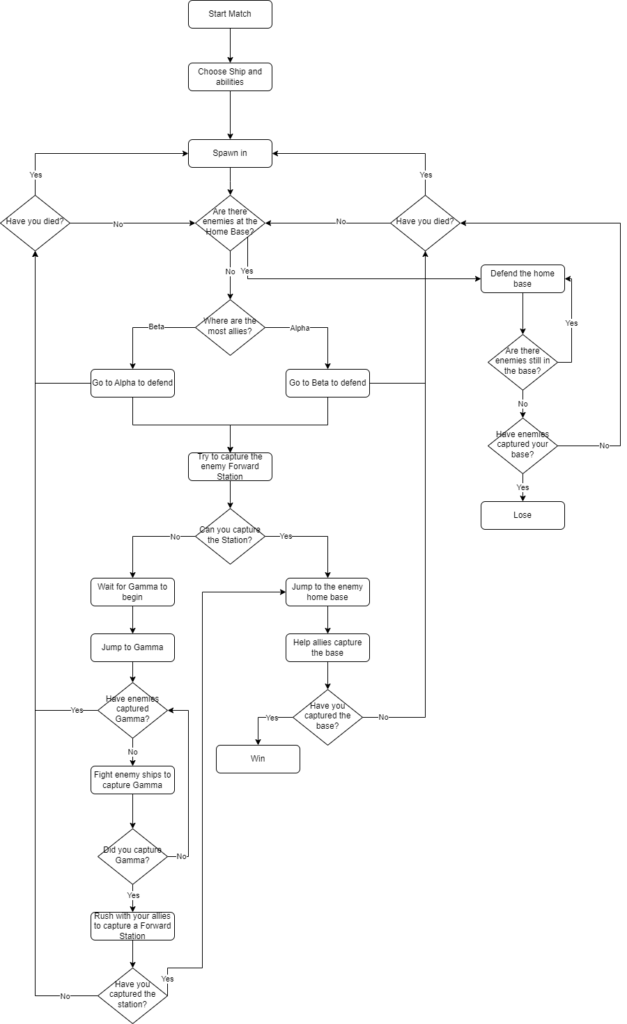
Gameplay flowchart for Fractured Space above ^ 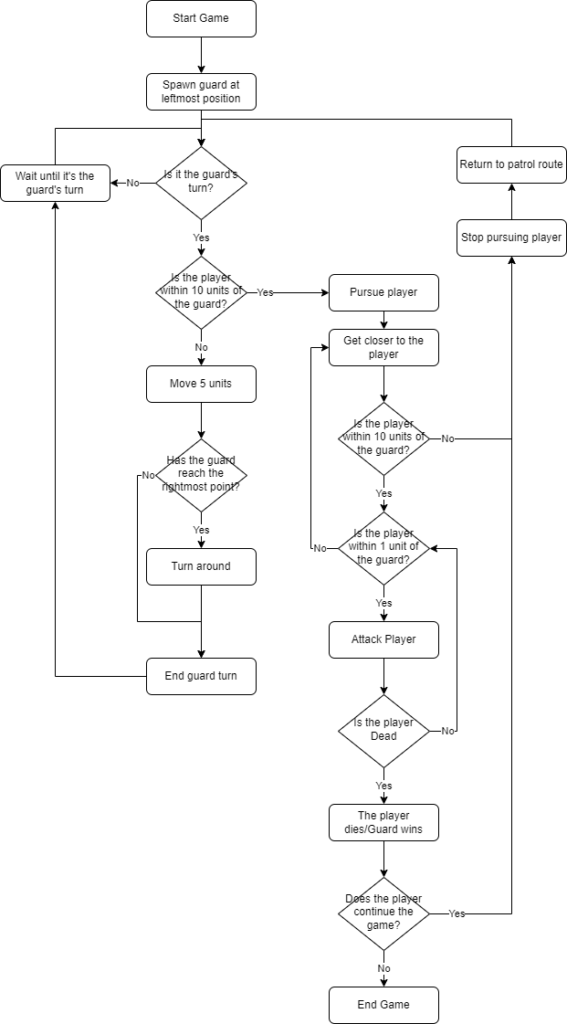
Guard patrol flowchart
Easing Graphs and Equations
Week Starting 17th October 2022
This week we did easing graphs and their related equations/functions. This was all about how values can be animated in a more natural way. Easing functions can be used to smooth out movements and make them look more like their real life counterparts.
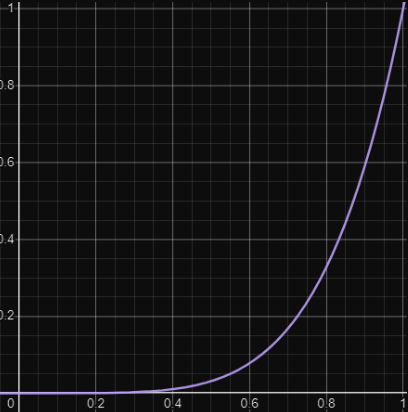
Above is an example of an easing graph I looked at, specifically x5. This one would be used for things like a car accelerating.
Also in this week, we looked at the comparison between frame based and time based animation, learning that frame based animation is more accurate than time based. The downside is that frame based is tied to the game speed meaning that framerate slowdowns will affect the speed of an animation.
2D Physics and Collision detection
Week Starting 24th October 2022
This week was all about 2D physics and how to apply collision detection to game objects. There were two main ways I looked at how collision detection is done in 2D games: Axis-aligned bounding boxes and Circle collision. Both of these have their own different uses.
An axis-aligned bounding box is the most basic type of collision detection, being just a rectagle that can’t rotate and will scale to fit the whole sprite.
Circle collision is another basic detection type, but possibly more useful than axis-aligned bounding boxes. The was the case especially with my game prototype project since I had to include circle collision for the range and enemy detection for my turrets.
Phaser Classes and Uses In Games
Week Starting 31st October 2022
For this week, we learned about the different types of classes in phaser. Honestly there’s not much to say about this week. It was the official start for my project and I just learned the classes I have been using as I needed them. For example, I added a delay for enemy spawning that can be updated per wave.
I also had to keep track of the mouse and display a turret’s range as the mouse hovered over it.
Working on Prototype Project 1
Week Starting 7th November 2022
My project started with a guided walkthrough on how to make a basic tower defence game. It was, in fact, very basic. The game started off with no wave system, no money, no lives and no UI. After following the guide to create the basic classes and map code, I had to plan what to do next.
My plans for the rest of this project is to flesh out the game, add a proper UI, add waves and upgrades, along with money and lives.
So far, I’ve added a way to see the range of a turret when you hover over it, and also made the map about 3x as big. I will do more next week.
Working on Prototype Project 2
Week Starting 14th November 2022
This week, I grinded out making a waves system, which was harder to do that I thought. I also got lives and money added to the game. I improved the UI, adding a title screen, a win screen, and a lose screen.
I need to get better at writing blogs but I feel like I’m too busy to really work on it.
Hand in week
Week Starting 21st November 2022
This week has been a busy week, with trying to get everything together and up to the right standard. I’ve also been working a lot on my game and got the upgrades system added. There are 4 attributes that can be upgraded; damage, firerate, bullet speed, and range.
I managed to get everything done in time, so just need to add the finishing touches and I’m done.